Apropos of nothing, here are some things I want that I will probably never acquire. Sigh. Being a materialist is such a disappointment. I don't have a Pinterest account, so this is where they will be immortalized. Until next month when I find something else I dearly desire but cannot have.
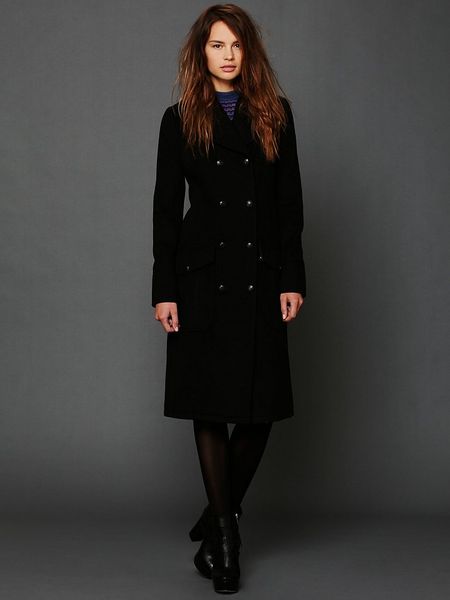
Free People Sargeant wool coat Can't find this anywhere in a larger size, so I'll never even know if it would fit. Maybe it didn't come in a larger size. I have actually touched one, but it was an Extra Small.
Or this one, although I'd prefer a longer coat. Never seen one "in the flesh".
Free People Military wool coat.
If I can't have that one, I'd take this Alexander McQueen coat..
Completely impractical as a coat, but very smart-looking.
Newport News velvet coat.
Frye Veronica slouch boots I love Frye boots. But they are so expensive.
These are cheaper and probably not bad boots. But they are difficult to find in my size.
Steve Madden 'Fairmont' boots.
I actually have a pair of these. They're are very comfortable. Lucky Brand 'Sweet N Straight' cords Sadly, I ripped the knee on the first wearing - I snagged a buckle on my
boot on the trouser leg (no, the trouser leg did not get caught in my
bicycle pump). The style has been discontinued, so I'll probably just
have to patch them and live with my misfortune..
Velvet frock waistcoat / sleeveless dress
It's pretty.
Well, that's enough of that. For now.
Thursday, January 23, 2014
Wednesday, December 25, 2013
To Sleep, Perchance to Write
SPOILER ALERT!
I have a confession to make: I've become a Sleepyhead. For those who haven't yet heard this term, it's the online name for fans of the new Fox Network dark fantasy series, Sleepy Hollow. For those who haven't heard of or seen Sleepy Hollow, it has taken Washington Irving's two best known fictional characters, Ichabod Crane and Rip Van Winkle, and blended elements of them into an engaging tale in which Crane awakens in 2013 after a 250-year magical sleep and must join forces with a sheriff's lieutenant to battle demonic forces that are attempting to bring about the End of Days. (Pauses to catch breath.)
There are many reasons I like the program: The engaging actor portraying Ichabod Crane; the chemistry between the two leads; the mythical premise with its references to Biblical prophecy, Freemasonry, witchcraft and other occult and supernatural elements; and the frequent use of historical flashbacks to the Revolutionary War.
But aside from those reasons, I think the real appeal for me comes from something else. For the past two years I have been working on a fantasy novel for which the premise bears more than a little resemblance to the plot of this series. My protagonist is a man who finds himself awakened in a new time, long after his normal lifespan would have ended, where he must pit himself against the forces of evil. The details of course differ from Sleepy Hollow, but the basic coincidence of concepts remains.
I'm not the sort of person to think that any idea I have is an original one, so this similarity doesn't trouble me. Others have written such stories and will again. But I do find it interesting that this program has inspired me to write more on my novel than I have in quite some time. It had been languishing untouched in my "story stub" file since last year, as I lost inspiration and my attention turned to writing other things. Watching Sleepy Hollow has inspired me to return to this story, to add new details to it and fill in blanks. So, in addition to enjoying Sleepy Hollow for its entertainment value (and for the dishy Tom Mison), I can enjoy it because it led me back to writing. Anything that inspires me to write is a good thing.
Thursday, November 28, 2013
The Doctor's Gone All Wibbly Wobbly Timey Wimey
Warning: This blog post will be full of spoilers from the 50th anniversary Doctor Who special 'The Day of the Doctor' and the minisode 'The Night of the Doctor'. If you haven't seen them yet and don't want to read spoilers, STOP READING NOW.
There, now that's out of the way, I can express all the thoughts that have been percolating in my Whovian fangirl brain since seeing 'The Day of the Doctor' on November 23rd (and again in 3D on November 25th).
The first issue I want to address is the regeneration of the Eighth Doctor in 'The Night of the Doctor'. It's a pity Paul McGann's first appearance onscreen as the Doctor since 1996 had to be a regeneration story, but at least now we know how the Eighth Doctor regenerated.
Except, the Eighth Doctor doesn't regenerate into the Christopher Eccleston Ninth Doctor. Instead, he regenerates into an incarnation of himself better suited to being a warrior, to fight in the increasingly desperate and terrible Time War. As we learn in 'The Day of the Doctor', this new version doesn't consider himself the Doctor anymore, feeling he isn't worthy of the name. But that isn't what's most important to my current thoughts. What's important here is that when Eight regenerates into the "War Doctor" (or the Other Doctor, as he's already being referred to online), the version of actor John Hurt we see replacing Paul McGann's face is much younger than the man who appears in 'The Day of the Doctor'.
During the events that take place in 'The Day of the Doctor', Doctors Ten and Eleven end up spending some time in a cell with their previously unmentioned predecessor - I'm going to call him Other for ease of identification. Ten at one point proclaims that he's 904 years old. When asked, Eleven states that he's 1200, but he sometimes gets confused, or maybe he's lying. This leads me to feel that not only have we been numbering the Doctors wrong ever since the series rebooted in 2005, but that the Doctor is quite a lot older than he tells us he is. When we first meet the Other Doctor, he looks older than he did in the regeneration scene because he's presumably spent centuries fighting in the Time War. Admittedly fighting in a war could age a person rapidly, and fighting in a Time War doubly so, but I still feel it's likely that Other was around for a very long time before he met his two successors. How long, we'll probably never know. Is Eleven's claim of 1200 years incorporating that time? I think not. I believe the figure of 1200 indicates that Eleven has spent 300 years in his present form, adding on to the 900 or so years he claims as Ten. So he is lying, because he's leaving out the time he spent as the Other Doctor. So, how old is the Doctor, really?
Back in 'The Deadly Assassin', we were told that a Time Lord could only regenerate twelve times, thus one could have only thirteen different versions of him/her self. The episode didn't explain whether this limitation was a biological, legal or social limit. If we renumber the Doctors to accommodate this previously unknown one, that means the upcoming version of the Doctor to be portrayed by Peter Capaldi will actually be number Thirteen. I'm not too bothered about bending or eliminating the Rule of Thirteen, since we've already seen that this rule could be waived for the Master - which makes it seem likely that it was a self-imposed limit and not one of Time Lord biology. Since the Doctor undoubtedly doesn't want to stop gallivanting about the Universe having adventures, and there aren't any other Time Lords around to enforce the rules, the Doctor can keep on regenerating as long as someone is willing to keep producing the show. And since the Time Lords he saved in 'The Day of the Doctor' may remember what he did even if he himself doesn't, they might even reward him by relaxing the regulations for him - assuming they ever manage to get out of the pocket universe he put them in.
I read a blog a few days ago in which the blogger theorized, based on the events that occurred in 'The Name of the Doctor', that Matt Smith's Doctor is actually the last Doctor, and Peter Capaldi's Doctor will precede him rather than follow him in chronology. (Unfortunately I can't find it now, but if I locate it later I'll add a link.) That will certainly give a big headache to the people who are worried about accuracy of numbering. It's an interesting theory, and the author proposed some compelling evidence to support it. I'm a bit dubious that Stephen Moffatt will go that far in messing with the chronology of Doctor Who, but it would be thought-provoking. I don't know how the script would handle that we saw David Tennant turn into Matt Smith.
In addition to thinking a lot about what this new Doctor means to the history of the character, I've also naturally been thinking a lot about the forthcoming regeneration when Matt Smith leaves the series with the upcoming Christmas special. Regeneration is the core of Doctor Who. The Doctor always changes. I've come to look forward to it. I'll miss Matt Smith, and I'd be equally happy if he decided to continue for another year. But I'm excited to see who the Doctor will be next. What will his personality be like? We've had Nine who was melancholy and guilt-ridden, always seeming like a man who was trying to fight off depression; and Ten who had some of that mingled with a more eccentric and playful attitude; and now Eleven who is aptly described as "a madman in a blue box". Even though we were told he wouldn't remember what happened in 'The Day of the Doctor' (apparently crossing your own time stream does that), I wonder if the next Doctor won't be a bit less eccentric, a bit more "grown-up" in his behavior. Not too grown-up, I hope. There's no point in being grown up if you can't be childish sometimes.
Of course we know what the next Doctor is going to look like, at least what his face will look like, but we don't know yet how he'll get there. The new version of the series has a pretty consistent regeneration style, with golden energy pouring out of him as his face morphs into its new form. But his last two regenerations have been under duress. Nine had to absorb the energy of the TARDIS from Rose Tyler's body. Ten suffered radiation poisoning to save Wilfred Mott from the same fate. But the Other Doctor regenerated as he had done the very first time he did so, when the First Doctor regenerated into the Second: his body was simply worn out. He actually seemed happy to change, in stark contrast to Ten's protest of "I don't want to go". What will cause Eleven to regenerate? Will he be happy about it or fight against it? Will he do it to save someone else, or to save himself?
And once he's in his new form, what will he wear? Recent iterations of the Doctor have dressed less eccentrically than some of their predecessors. The costumes worn by Christopher Eccleston and David Tennant could have passed on any present-day street as ordinary attire. Matt Smith's costume started out to be fairly mundane as well, though his recent switch to a velvet waistcoat and frock coat are bit less "normal". Will Peter Capaldi's costume follow that trend? As I was contemplating these questions, it occurred to me that the Doctor has shown a fondness for frock coats or long overcoats throughout his lives. Only his Third, Seventh and Ninth selves have elected to wear shorter jackets. Will his newest self follow the long coat trend? (I like the long coats, so I hope he has one.) What kind of costume-choosing scene will we get? Those have varied widely over the years. Several times the Doctor has essentially stolen clothing from someone else when no other option was available to him (Third, Eighth, Eleventh), while his Fourth, Fifth, Sixth and Seventh selves took a great deal of time deciding what to wear from the TARDIS wardrobe. I like a costume-choosing scene, but could do without some of the sillier ones (Fourth, Seventh). I just want to see him making a choice, and preferably some more TARDIS interiors.
The TARDIS tends to adapt its appearance to the changes in its occupant as well. Sometimes the Doctor redecorates without regenerating. Will it take on a new appearance for its new man? Does the TARDIS remember things the Doctor doesn't? We saw that the Other Doctor's TARDIS console room had the white "round things" that hearken back to the pre-reboot TARDIS decor. I'd be delighted if that design element continued into the new Doctor's version of the TARDIS. But even if it doesn't, I know the set designers will come up with something interesting.
That's what's so special about Doctor Who. There's always something new to look forward to.
Wednesday, October 2, 2013
Of Elves and Men
I love to play elves when I roleplay. Yes, I'm one of those people, the ones who think elves are more fun to play than any other playable race. Whether I'm playing D&D/Pathfinder or The Elder Scrolls V: Skyrim, my first choice is always to play an elf.
I'm not going to go into a long discussion here about why I like playing elves, though. Instead I want to talk about the elves as created by JRR Tolkien, which are largely the inspiration for elves in most fantasy roleplaying games, and how they differ from the elves in those RPGs, especially in D&D and its offshoots.
I'm a big fan of Tolkien's elves. I love the idea of these ethereal, fey people populating a world. But the elves Tolkien created are not the elves that got into D&D. The elves of Middle-Earth are for all practical purposes immortal. Unless they are slain by accident or violence, their lifespans have no limits. They don't show any external indication of aging and are never subject to death from extreme age. They are also the firstborn of Middle-Earth, the first sentient creatures made by the god Eru and given free will. They are halfway between the angelic Valar and Maiar, which could be equated with celestials in D&D terms, and the mortal races: Dwarves, Hobbits and Men.
If modeled in D&D rules without any change, they'd probably be more like the eladrins, which are a type of celestial elf, though perhaps without some of the magical abilities given to the eladrins. Elves of Middle-Earth are clearly magical - Galadriel seems capable of telepathy and clairvoyance, Legolas can walk on top of deep powdery snow - but their magic doesn't run to the same variety as what is assigned to the eladrins.
I understand some of the reasoning behind making D&D elves so much less powerful. D&D elves are naturally good at using magic, but they aren't innately magical beings. They aren't celestial, either. If they were more magical, or celestial, it would create an imbalance in the game. Much of the rules of D&D and similar games are designed to make sure no one player-character is significantly more powerful or skillful than any other character. So the designers of roleplaying games have lessened the elves, taken away much of the power and majesty Tolkien gave them.
Another important feature the elves lost in translation was their immortality. This one I miss somewhat, just for roleplaying reasons, though I understand how hard it is to model that in a game with rules like those of D&D. Although D&D and its relatives have rules for aging, they seldom come into effect. I've never met anyone who played the same D&D character long enough for the character to grow more than a few years older. In some past editions of D&D there were magical effects that could cause a character to age unnaturally, but those have largely been lost by current versions of the game. In practical terms age doesn't mean much in the game. A character is much more likely to die by violence or accident than to die of old age.
Why, then, can't D&D elves still be ageless? Because when you're trying to show a character's level of knowledge and experience in a game like D&D, you have to represent those things with concrete numbers. Every character gets a different set of numbers to work with, but only within a certain range. Like many console games, characters in D&D have levels to represent increases in their knowledge, experience, skills and special abilities. It's typical for all characters in a group to start out at the same level. To represent a character who is a thousand years old, you'd expect that character to have much more knowledge and experience than other characters that have lived far less. A thousand-year-old elf would be many levels higher than a 20-year-old human. But a character of higher levels in D&D has more of everything: more skills, more abilities, more weapons, more magic, more wealth. One high-level character can do things that would take three or four characters of a lower level to achieve. It wouldn't be very fun for the players of the lower-level characters if every time they faced a challenge, the higher-level character stepped in and stole all the glory.
I've tangled with this age issue in the past with elf characters I've played. If my elf is 175 years old at the start of a new campaign, why is she still only a first-level character? What was she doing with her time? I have to rationalize that if she's a wizard, for example, she spent most of those years learning magic. That rationalization still doesn't quite work, because another player could play a human wizard who's only 21 years old and yet be just as good or even better at magic than my elf. I've never found quite the right way to explain this disparity. I just have to overlook it.
I still wish there was a way to make D&D elves a little more like Tolkien's elves. I suppose much of that will have to come from my imagination as roleplaying rather than from the game's rules. The minor frustration of not being able to realize my dream won't prevent me from enjoying playing elves for a long time to come.
Thursday, August 29, 2013
Give Me Some Good Old-Fashioned Superheroics
My husband and I have recently been re-watching episodes of the animated Justice League Unlimited tv series. Aside from just being fun, it's reminded me how much I like superheroes, comic books, and superhero RPGs, and how I wish I was still involved in a superhero campaign. Aside from traditional fantasy, superheroes is the only other genre of RPG I really enjoy.
My first experience with a superheroic campaign occurred in about 1996-7. One of our fantasy campaign GMs also ran a superhero campaign, using the Champions! Hero System RPG. My husband and I asked if we could sit in after hearing our other friends talk about the game. The GM agreed, since his Champions! group had recently decreased in size. But since my husband and I hadn't played much Hero System, the GM had us play characters that had already been created by other players who were no longer participating in the game. My first Champions! character was an elastic stretching guy similar to Mr. Fantastic or Plastic Man. His name was Strider. My husband took on Inertia, a classic flying blaster whose powers were telekinetic. The rest of the team was composed of Mind Shadow, a telepath; Shockwave, another flying blaster with energy-based abilities; Kien, a martial artist who also had the ability to teleport in short bursts; Yao-shi-fo, a mystical Chinese dragon in human form who was the team's magic-user; and EtherealGirl, the GM's NPC teen sidekick, who could become intangible.
The campaign was set in the city we all live in, which isn't a large city but in the campaign it managed to have plenty of attacks by alien invaders, megalomaniacal supervillains, evil androids, and all the other foes four-color heroes typically face. It was also kept a bit behind real-world historical continuity. Time tended to pass very slowly in the game world. Each game session took place in game time that was only a few days after the events that occurred in the previous session, so that by the time an entire year of real world time had passed, only a few weeks of game time had gone by, since we played about twice a month.
After my husband and I learned a bit more about the rules by running Strider and Inertia, we created our own characters. Strider retired to focus on his family and career, and Inertia went off to college. My husband created Ground Pounder, an ex-supervillain with incredibly elongated arms who could leap great distances and create seismic shocks. My first hero was Chimera. She came from another version of reality that was more technologically advanced than the real world or the game setting. In her reality, superheroes were controlled by the government and organized into a kind of international law enforcement agency. She had been given nanotechnology that allowed her to manifest body armor, functional wings and projectiles, as well as giving her enhanced strength and speed. She was transported to the game version of Earth by a transporter malfunction.
I had tried to make Chimera versatile, but unfortunately I ended up making her a jack of all trades and master of none. She wasn't strong enough to stand up to the big guns in combat, and since most of our sessions were largely combat, I felt ineffectual. After a while I decided it was time for a change. Fortunately, in a superhero campaign, it's easy to find an excuse to swap out characters. Chimera was found by people from her reality and taken back home, and in her place Shocking Pink joined the team.
I've never liked multisyllabic names for superheroes, but for some reason the name Shocking Pink pleased me. She was an electrically powered heroine. When I created her I got help from my friend who ran Kien, who is a master at creating characters with great powers without having to spend an excessive amount of character building points. Shocking Pink could do almost all of the things I wanted her to be capable of. She could fire several different types of electrical blasts, transport herself by passing through electrical wiring and other conductive materials, even zap one target and have the blast arc to a second target. I also gave her a twin, whose powers were identical except that Pink fired pink blasts and her twin's blasts were blue, hence her name: Electric Blue. In classic comic book style, Electric Blue had chosen the other side of the law. Sadly my plans for having them be evenly matched didn't come to much; when the GM did bring the evil twin into play ( which was seldom), her powers had changed so that she and Shocking Pink were no longer twins.
I had a lot of fun playing Shocking Pink anyway. Around the same time, the player running Kien started a Champions! campaign of his own. His game was set in the fictional city of San Angelo, which was much bigger than the location for the first campaign. We started with a team of heroes who met for the first time in our first session. My heroine in that campaign was Xcel. I chose the name because she excelled at many things. She could run 60 miles an hour, throw a car, leap to the roof of a five-story building, regenerate from wounds that would be fatal in an ordinary person. She also had enhanced vision and hearing, and I gave her a couple of levels of density increase to boot. She was a lot of fun to play, too.
Our second superteam was composed of Elemento, son of superheroes who commanded the elements of earth, air, fire and water and also had some telepathic powers; Zora, a powerful warrior who had been transported from a medieval fantasy world (she had been the player's character in a prior RuneQuest campaign); and Night Mask, an old-school Batman-style hero who had been retired but had suddenly returned to action (actually it was a new Night Mask, as we eventually discovered, the daughter of the previous one). We took over protecting San Angelo when the city's existing team retired or otherwise became unavailable. We eventually acquired an abandoned alien spacecraft as our home base, which was fun because we didn't entirely know how to operate everything in it. We had a lot of exciting adventures... up to the point that the GM lost his zest for running the game and it came to an end. I never got to find out what secret organization was menacing Xcel's family.
Several years later another friend decided to run a short-term campaign using the d20 rules superhero setting Mutants & Masterminds. It was a bit of a challenge creating characters in a new system, even though I was familiar with general d20 rules. I chose to create Fluxx, a character made of fluid metallic substance who could shapeshift in a limited sense. As with Chimera, I was never entirely satisfied with her build, but I still had a good time playing with my friends. This time the rest of the team was made up of speedster Dash, telepath Guardian, crystalline Crystal, and two other characters whose names and powers sadly escape my memory now. The campaign had a bit of a meltdown after a little while and was discontinued.
Eventually the same GM decided to give us another chance, although this time the group didn't include the two players whose characters I can't remember from the first campaign. Once again my desires for my character weren't possible to achieve within the limits of the rules. My fascination with Chinese martial arts movies had inspired me to play a martial artist, Jade Dragon. Jade was only good for taking out mooks. She just didn't have the strength or stamina to fight someone with powers. But the campaign was still a lot of fun because we worked well together and the other characters were well designed. My husband played Lord Astral, a 19th-century wizard who was revived from magical suspended animation in the 21st century. Our other friends ran Grunt, a "brick" (tough and strong) who had melded with some alien technology, and Solar Flare, a flying blaster who with solar energy powers who had acquired her abilities from a scientific mishap. Even though I wasn't happy with how Jade Dragon turned out, I still enjoyed the campaign and was disappointed when it was over.
As you can see, I've had a fair amount of experience playing superheroes. None of my characters ever had all the abilities I wanted them to have, but most of the time I didn't mind that too much. I still think often of superhero games and how much I like them. I have to say that I prefer Champions! to Mutants & Masterminds. It's more complicated when it comes to combat - a single combat in Champions! can last for four hours of real time - but it's more versatile than M&M. If our San Angelo campaign hadn't ended, I could have made Xcel into everything I wanted her to be. I doubt I would ever have been able to do that with Fluxx or Jade Dragon.
Someday I hope one of my GM friends will again want to run a superhero game. I hope we'll be able to go bigger than the games I've participated in previously, which tended to focus only on fighting local problems. Someday I want to be in something like the Justice League or the Avengers, fighting international and interplanetary threats. I wouldn't mind if our characters were second string heroes, I'd just like to be able to fight off alien invasions or interdimensional threats alongside the big guns. Let us defend the Earth against Darkseid or Magneto instead of some crime syndicate. Let me play a character who starts out with most of the powers I want already in place.
And while I have great nostalgia for my first superhero campaign and will always be grateful to the friend who let me join it, I hope my next superhero campaign lets me grow my character. Not her powers, but her. She needs a background that actually has an effect on the campaign, things and people to care about, and a life that involves more than four-hour combat sessions.
Now I'll return to hoping that someday I get my wish, and planning for the next superhero I'll play.
My first experience with a superheroic campaign occurred in about 1996-7. One of our fantasy campaign GMs also ran a superhero campaign, using the Champions! Hero System RPG. My husband and I asked if we could sit in after hearing our other friends talk about the game. The GM agreed, since his Champions! group had recently decreased in size. But since my husband and I hadn't played much Hero System, the GM had us play characters that had already been created by other players who were no longer participating in the game. My first Champions! character was an elastic stretching guy similar to Mr. Fantastic or Plastic Man. His name was Strider. My husband took on Inertia, a classic flying blaster whose powers were telekinetic. The rest of the team was composed of Mind Shadow, a telepath; Shockwave, another flying blaster with energy-based abilities; Kien, a martial artist who also had the ability to teleport in short bursts; Yao-shi-fo, a mystical Chinese dragon in human form who was the team's magic-user; and EtherealGirl, the GM's NPC teen sidekick, who could become intangible.
The campaign was set in the city we all live in, which isn't a large city but in the campaign it managed to have plenty of attacks by alien invaders, megalomaniacal supervillains, evil androids, and all the other foes four-color heroes typically face. It was also kept a bit behind real-world historical continuity. Time tended to pass very slowly in the game world. Each game session took place in game time that was only a few days after the events that occurred in the previous session, so that by the time an entire year of real world time had passed, only a few weeks of game time had gone by, since we played about twice a month.
After my husband and I learned a bit more about the rules by running Strider and Inertia, we created our own characters. Strider retired to focus on his family and career, and Inertia went off to college. My husband created Ground Pounder, an ex-supervillain with incredibly elongated arms who could leap great distances and create seismic shocks. My first hero was Chimera. She came from another version of reality that was more technologically advanced than the real world or the game setting. In her reality, superheroes were controlled by the government and organized into a kind of international law enforcement agency. She had been given nanotechnology that allowed her to manifest body armor, functional wings and projectiles, as well as giving her enhanced strength and speed. She was transported to the game version of Earth by a transporter malfunction.
I had tried to make Chimera versatile, but unfortunately I ended up making her a jack of all trades and master of none. She wasn't strong enough to stand up to the big guns in combat, and since most of our sessions were largely combat, I felt ineffectual. After a while I decided it was time for a change. Fortunately, in a superhero campaign, it's easy to find an excuse to swap out characters. Chimera was found by people from her reality and taken back home, and in her place Shocking Pink joined the team.
I've never liked multisyllabic names for superheroes, but for some reason the name Shocking Pink pleased me. She was an electrically powered heroine. When I created her I got help from my friend who ran Kien, who is a master at creating characters with great powers without having to spend an excessive amount of character building points. Shocking Pink could do almost all of the things I wanted her to be capable of. She could fire several different types of electrical blasts, transport herself by passing through electrical wiring and other conductive materials, even zap one target and have the blast arc to a second target. I also gave her a twin, whose powers were identical except that Pink fired pink blasts and her twin's blasts were blue, hence her name: Electric Blue. In classic comic book style, Electric Blue had chosen the other side of the law. Sadly my plans for having them be evenly matched didn't come to much; when the GM did bring the evil twin into play ( which was seldom), her powers had changed so that she and Shocking Pink were no longer twins.
I had a lot of fun playing Shocking Pink anyway. Around the same time, the player running Kien started a Champions! campaign of his own. His game was set in the fictional city of San Angelo, which was much bigger than the location for the first campaign. We started with a team of heroes who met for the first time in our first session. My heroine in that campaign was Xcel. I chose the name because she excelled at many things. She could run 60 miles an hour, throw a car, leap to the roof of a five-story building, regenerate from wounds that would be fatal in an ordinary person. She also had enhanced vision and hearing, and I gave her a couple of levels of density increase to boot. She was a lot of fun to play, too.
Our second superteam was composed of Elemento, son of superheroes who commanded the elements of earth, air, fire and water and also had some telepathic powers; Zora, a powerful warrior who had been transported from a medieval fantasy world (she had been the player's character in a prior RuneQuest campaign); and Night Mask, an old-school Batman-style hero who had been retired but had suddenly returned to action (actually it was a new Night Mask, as we eventually discovered, the daughter of the previous one). We took over protecting San Angelo when the city's existing team retired or otherwise became unavailable. We eventually acquired an abandoned alien spacecraft as our home base, which was fun because we didn't entirely know how to operate everything in it. We had a lot of exciting adventures... up to the point that the GM lost his zest for running the game and it came to an end. I never got to find out what secret organization was menacing Xcel's family.
Several years later another friend decided to run a short-term campaign using the d20 rules superhero setting Mutants & Masterminds. It was a bit of a challenge creating characters in a new system, even though I was familiar with general d20 rules. I chose to create Fluxx, a character made of fluid metallic substance who could shapeshift in a limited sense. As with Chimera, I was never entirely satisfied with her build, but I still had a good time playing with my friends. This time the rest of the team was made up of speedster Dash, telepath Guardian, crystalline Crystal, and two other characters whose names and powers sadly escape my memory now. The campaign had a bit of a meltdown after a little while and was discontinued.
Eventually the same GM decided to give us another chance, although this time the group didn't include the two players whose characters I can't remember from the first campaign. Once again my desires for my character weren't possible to achieve within the limits of the rules. My fascination with Chinese martial arts movies had inspired me to play a martial artist, Jade Dragon. Jade was only good for taking out mooks. She just didn't have the strength or stamina to fight someone with powers. But the campaign was still a lot of fun because we worked well together and the other characters were well designed. My husband played Lord Astral, a 19th-century wizard who was revived from magical suspended animation in the 21st century. Our other friends ran Grunt, a "brick" (tough and strong) who had melded with some alien technology, and Solar Flare, a flying blaster who with solar energy powers who had acquired her abilities from a scientific mishap. Even though I wasn't happy with how Jade Dragon turned out, I still enjoyed the campaign and was disappointed when it was over.
As you can see, I've had a fair amount of experience playing superheroes. None of my characters ever had all the abilities I wanted them to have, but most of the time I didn't mind that too much. I still think often of superhero games and how much I like them. I have to say that I prefer Champions! to Mutants & Masterminds. It's more complicated when it comes to combat - a single combat in Champions! can last for four hours of real time - but it's more versatile than M&M. If our San Angelo campaign hadn't ended, I could have made Xcel into everything I wanted her to be. I doubt I would ever have been able to do that with Fluxx or Jade Dragon.
Someday I hope one of my GM friends will again want to run a superhero game. I hope we'll be able to go bigger than the games I've participated in previously, which tended to focus only on fighting local problems. Someday I want to be in something like the Justice League or the Avengers, fighting international and interplanetary threats. I wouldn't mind if our characters were second string heroes, I'd just like to be able to fight off alien invasions or interdimensional threats alongside the big guns. Let us defend the Earth against Darkseid or Magneto instead of some crime syndicate. Let me play a character who starts out with most of the powers I want already in place.
And while I have great nostalgia for my first superhero campaign and will always be grateful to the friend who let me join it, I hope my next superhero campaign lets me grow my character. Not her powers, but her. She needs a background that actually has an effect on the campaign, things and people to care about, and a life that involves more than four-hour combat sessions.
Now I'll return to hoping that someday I get my wish, and planning for the next superhero I'll play.
Saturday, August 17, 2013
Growing the Garden of You
Two weeks ago a coworker who was my mentor and to a certain extent my friend was fired. Yesterday I found out that he had passed away. I have a lot of thoughts about this running around in my head, but foremost among them is the feeling that my coworker didn't have a good support system. His family lives across the country. He didn't seem to have many friends who could help him out when he was in need.
Having relationships with other people is a bit like growing a garden. You have to decide what you want to put in it, how big you want it to be, and whether you want plants that are easy to care for, plants that bear fruit or vegetables, or plants that smell nice and are pretty to look at. Once you determine that, you have to put in some work to keep it up. If you don't look after your garden, it might be completely overtaken by weeds or die.
Personal relationships are like that garden. To have friends takes effort. First, to make friends you have to be a friend. You have to be generous and supportive and respectful and interested, and sometimes you have to do those things even when you're not getting anything in return from the other person. You also have to be careful about who you let into your garden. If your friends don't make you feel good about yourself and proud to count them among your friends, they shouldn't be a part of your life. It's okay to have some friends who are just casual friends, people you socialize with but don't expect them to help you move. But they should still be people who make you feel good about you and about spending your time with them. Don't let your garden fill up with weeds.
Don't let your garden die, either. Keep in touch with your friends. Ask them how they are from time to time. Make time to see them or call them. Don't keep saying to yourself, "I should really get in touch with X" and never following up on it. You never know what can happen. It's true that sometimes friends just grow apart, that whatever it was that made you friends in the first place can fade away, or people change and their personalities and interests no longer mesh with yours. But when that happens, don't say to yourself, "I can't make friends". Go out and actively look for new friends. Go and try new activities, go to new places, don't be afraid to approach people you think might be good candidates and test the waters. If it doesn't work out, so what? Try again. Don't be afraid of failure.
I wish I could have said these things to my coworker, but I don't know if he would have listened. I just hope that someone else might read this and give some thought to how their garden of friends is growing.
Saturday, August 3, 2013
To Tattoo or Not Tattoo
I grew up in the 60s and 70s, when tattoos were something that only sailors, ex-cons and carnies had. When tattooing started to become more popular in the alternative culture a few years ago, I had my doubts, based on my upbringing. Tattoos weren't something to be proud of, they weren't something "nice" people had.
But as tattoos became more common, I started seeing them in unexpected places, on unexpected people. I knew they'd become mainstream when I noticed that an otherwise fairly conservative woman from my employer's human resources department had a tattoo on her ankle. The general quality of available tattoos has also dramatically improved. They are body art, not tacky things done in a back-alley tattoo parlor in Bangkok. I started to like and admire them.
But I still didn't want one. They hurt, of course they hurt, no matter what some people claim. It's a needle repeatedly jabbing you. It's painful, the amount of pain varying dependent on the body location, the complexity of the design, and the pain tolerance of the individual. My pain tolerance isn't great, so I'm afraid of the pain. They're also expensive, if you get an elaborate one with lots of intricate design and color. Tattoo sleeves are often gorgeous, but they take hours and lots of money to complete. What if you run out of money and can't get your design finished?
But it wasn't really the pain or the expense that made me feel I'd never want a tattoo. It was the indecision. What would be the right design for me? Where on my body would be the best spot? What happens when I get older and my skin stretches and sags and the tattoo no longer looks as attractive as when it was new? What if I get bored with the design, or just don't like it anymore after a few years? I was sure that a tattoo would never be the thing for me, because I'd never be able to pick a design that I could live with for the rest of my life, and I was afraid I'd be stuck with something I wasn't happy with and couldn't afford to have it removed. Something that permanent is scary. I have pierced ears, but if I decide I don't want pierced ears anymore I can just stop wearing earrings and in a year or less the holes will grow shut. But my body's natural defenses won't get rid of a tattoo. Once you get one it's for the rest of your life.
A few months ago I decided that I really like the gauge earring styles that have become popular with people who stretch their earlobes. I don't want to wear huge plugs or stretch my lobes so they hang down to my shoulders, but I do want the option to wear larger gauge "tribal" style earrings. So I bought some stretching gauges and started stretching my piercings. I'm up to 10 gauge now. I haven't decided if I'll go bigger, but I'll probably stop at 10 or possibly 8 gauge, no more. It's still small enough that the holes will shrink if in the future I decide I don't like it anymore, and I can still wear ordinary earrings if I don't feel like wearing the larger gauge ones.
This act of stretching my piercings has awakened in me a desire for a tattoo. I have a design or two in mind, things I think I can be happy with for the next 20 years. I've chosen a spot on my body where the ravages of aging shouldn't have too severe an impact, where I can also easily hide the tattoo if I want to: My back, between the shoulder blades just below the base of my neck. I've decided not to go for color, because color fades and I don't want to have to worry about touch-ups. Now all I need is to make the final decision on the design and save some money for the actual inking. I'm contemplating getting a henna tattoo of the chosen design first, so I can live with it for a few days and see if I really like it.
The process of deciding on a possible design is difficult. I like lots of things and have many interests. Should I have a tattoo of something that represents my sci fi / fantasy fandom? A Star Wars Rebel Alliance emblem, or the One Ring verse in Elven script? I think not. Much as I love my fandom, I don't think I want a representation of it permanently displayed on my skin. I can't choose which part of that fandom I love more than any other part. I also love Chinese language. Should I have some characters or a quote tattooed on my back? Lots of people have Chinese characters tattooed on their skin. I don't want to look like every other tattooed person. I want something that makes me happy, something that I can admire in the mirror, something other people will hopefully admire when I choose to permit them to see it.
Here are a couple of designs I'm contemplating.
This is a mehndi design. I like the lotus shape - I love lotus flowers. It also has spirals in it, a shape I'm really drawn to. It's detailed without being too intricate, and it looks good as a simple outline without any color.
These are more mehndi designs. I like the sun face second from the top, although I might want to make some minor modifications to it. I like the rays, but I'm not entirely happy with the lips.
This one isn't an image file. In the upper left corner of this page there's a design that resembles an eye. It also reminds me of a cloud. I really like it. It's a good graphic design, it's simple, it's Chinese, and it reminds me of a place that I hope to visit someday. So it would represent both hope and beauty for me.
I'm trying not to find too many designs. I don't want to make the choice difficult for myself. My first thought was to go with the design from Jiuzhai Valley's website, but it's almost too simple, and looks too much like an eye. Now I'm leaning toward a design like the mehndi lotus, perhaps with some modification to make it more personal to me. We shall see if I ever actually settle on a design and take the next step toward getting an actual tattoo.
Subscribe to:
Posts (Atom)

